Appearance
Checklists
Checklists are an additional concept on top of Field Settings for assets.
Asset field settings ensure that data is valid for system use. But the system can only let us know what fields have been provided at best.
The checklists are an additional layer of validation where an actual user ensures and validates entered data for assets.
The Checklists Tab allows viewing/modifying settings pertaining to a checklist. Checklists cannot be created/deleted, only existing checklists modified.
To modify a checklist item's setting, use the field option toggle visible on the item's row, and then click the Save button.
User can choose to create new items within a checklist. To do so, click on the + button on the top right corner of the checklist items table (or click the + button on a checklist item row to create a nested item). Fill in the resultant form and press save.
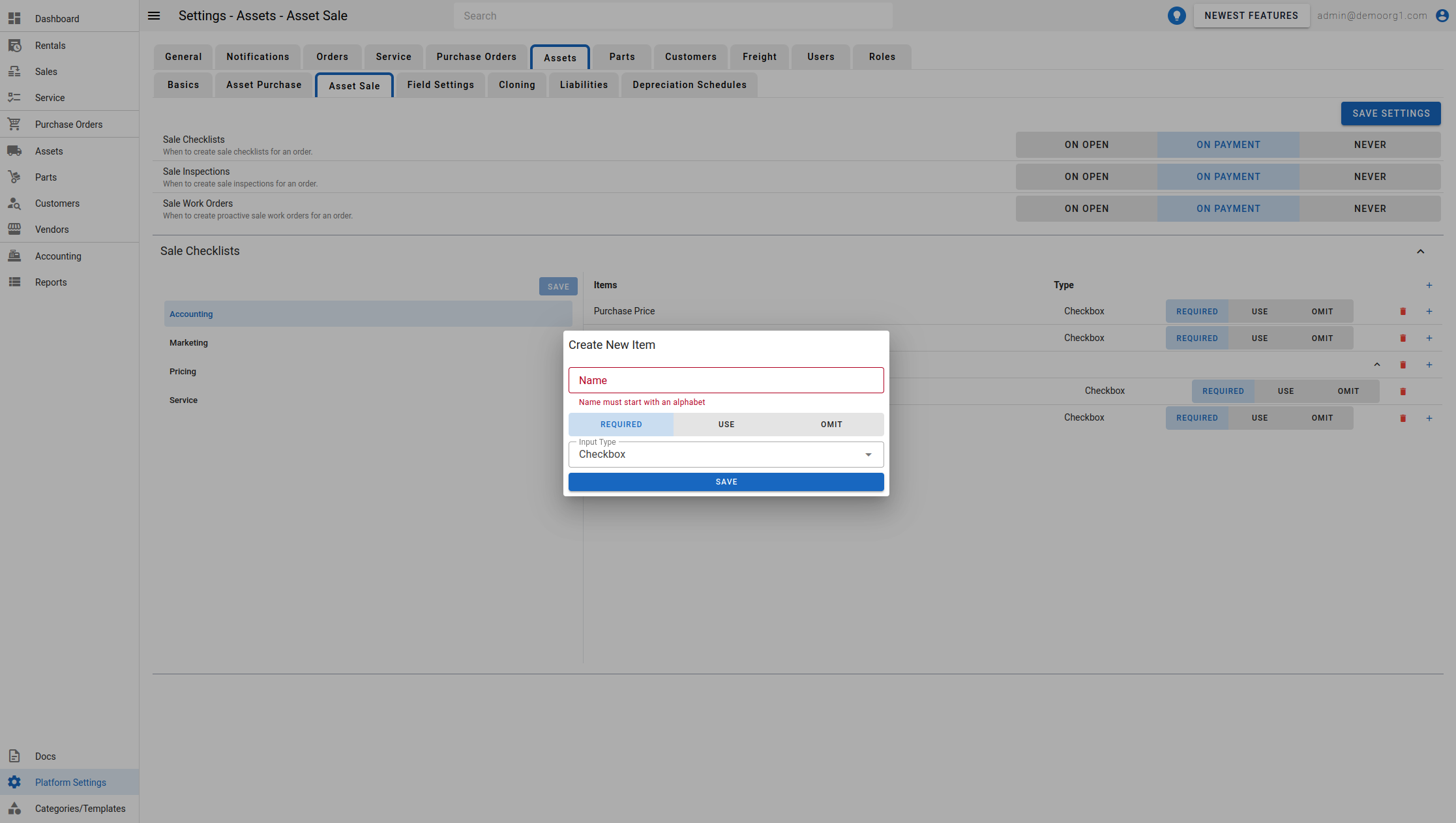
When creating an item you can choose its Input Type, which controls how the item is answered when the checklist is filled in:
- Checkbox — a simple tick (the default).
- Text — a free-text entry.
- Dropdown — a single choice from a fixed list. When you pick Dropdown, an Options field appears where you add the selectable values (at least one option is required — "Add at least one option").
The item Name must start with a letter, but can otherwise contain any characters (spaces, punctuation, and other symbols are allowed) — the only rule enforced is "Name must start with an alphabet".
You can also give an item a Data Association — pick an asset field from the grouped Data Association list to link the item's answer to that field. When an association is set, the item's row shows a "Fills in: <field>" chip, indicating that answering this checklist item populates that asset field. Leave it unset for a checklist item that is purely a manual check.
INFO
Checklist items can be nested one level deep — use the + button on a top-level item's row to add a nested item; nested items themselves cannot be nested further. Creating, editing and deleting items (including their data association) requires the field-settings update permission; without it the item controls are read-only.
To delete a checklist item, use the delete icon on its row.
Editing The New Asset Detail Checklist Question Set
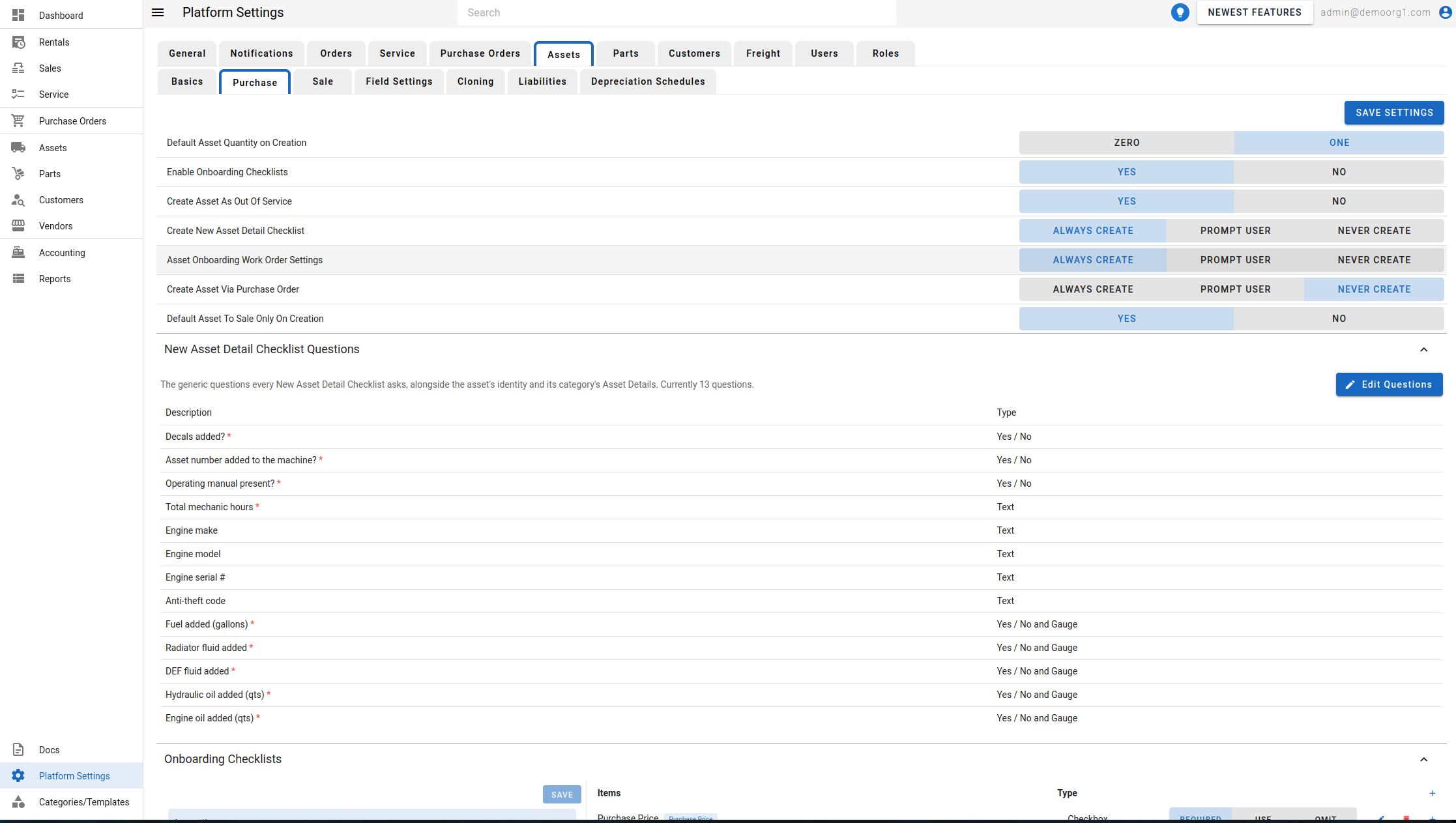
The generic questions asked on every New Asset Detail Checklist — alongside the asset's identity and its category's Asset Details — are a single, organization-wide question set, edited from the Purchase tab (Platform Settings → Assets → Purchase).
The current questions now show as a list right on this page — a Description and Type column per question, with required questions marked by a red asterisk — so you no longer need to open the editor just to see what's configured.
Click Edit Questions to open the familiar Form Template editor for this question set. As with other form templates, each question has a Description, an Item Type, and (for a single-select question) a list of selectable Options. This question set does not belong to any category, so it has no Template Scope to set, and it isn't reachable from the Categories/Templates pages.
The Item Type options offered for a New Asset Detail Checklist question are:
| Item Type | How the technician answers it |
|---|---|
| Text | A free-text field. |
| Number | A numeric entry. |
| Dropdown | A single choice from the Options you define. |
| Pass / Fail | A two-button Pass / Fail toggle. |
| Yes / No | A two-button Yes / No toggle. |
| Yes / No and Gauge | A Yes / No toggle paired with a numeric reading. |
| Check and Gauge | A toggle paired with a numeric reading. |
The two photo types (Damage and Photo and Gauge and Photo) are for Inspection templates only and are not offered here. Each option in the Item Type dropdown is also annotated with every kind of template it can be used on, e.g. "(Asset Details, Inspections, NADC)". Every non-photo type can be used on Asset Details, Inspection and NADC templates alike. The old Checkbox type has been retired in favor of the Yes / No question.
Renaming A Question
To rename a question already on the set, hover over its row in the right-hand list of selected questions in the editor and click the pencil icon (Rename Question). The item popup opens with the Description editable; the Item Type is locked while renaming. Click Save to apply the new name.
INFO
A question is a shared form item, so renaming it changes it on every template that uses it. If the question is also on other templates, an alert in the popup lists them: "This question is also on N other templates (...). Renaming it changes it there too." The rename pencil only appears for users granted the form template update permission, and only on questions already saved on the set (not ones you have just picked from the left and not yet saved).
Work Order/Order Discount
This discount can be set on the work order or rental order in question. This is the second step of discounts, and is applied on the order/work order total, inclusive of fees but exclusive of taxes.
Customer Discount
This discount can be set for a customer. This is the third step of discounts, and is applied on the order's total, inclusive of fees but exclusive of taxes.
INFO
Customer Discounts are only applied on rental orders, not work orders
INFO
Customer Discounts can be toggled off on rental orders
Line items always show the total cumulative discount that will be applied on the item, i.e. Line Item Discount + Work Order/Order Discount + (Customer Discount for Rental Orders) . The user can choose to edit this amount, which will add/subtract an additional discount percentage on the item, but only such that the cumulative discount on the line item never exceeds the maximum percentage of discount that a user with a certain role can offer to customers.
Similarly, rental orders always show the total cumulative discount that will be applied on the work order/order, i.e. Order Discount + Customer Discount. The user can choose to edit this amount, which will add/subtract an additional discount percentage on the rental order, but only such that the cumulative discount on the order never exceeds the maximum percentage of discount that a user with a certain role can offer to customers.
Flat Discount
In addition to offering percentage discounts, a user can also offer a flat discount in terms of dollar value on a rental discount. However, cumulative discount on the order can never exceeds the maximum percentage of discount that a user with a certain role can offer to customers.