Appearance
Processing a Purchase Order
Purchase Orders are a means of purchasing and stocking assets/parts into inventory, or ordering parts against a work order.
When Purchase Orders are created, they are set to the new status. All info on a purchase order with new status is editable.
Once a Purchase Order is finalized, it is released to the vendor, thus marking the purchase order's status as released.
Once any item on a released purchase order has been received, but at least one item is still outstanding, the purchase order's state is shown as partially_received. A partially received purchase order behaves like a released one — its remaining unreceived lines can still be received against, and can still be allocated to work orders — until either the rest of its items are received (moving it to received) or it is closed short (see below).
Once all items within a purchase order have been received, the purchase order is marked as received, indicating that no more items will be received against that purchase order.
At this point, vendor invoices can be recorded against the purchase order's received items and reconciled against what was ordered and received — see Reconciling A Purchase Order. The purchase order is then moved to closed manually, as described below. Follow the steps below to create and process a purchase order in ERM:
Step 1 - Create Purchase Order
Step 2 - Release Purchase Order
Once items have been added to a purchase order and it's details have been finalized, the purchase order is ready to be released to the vendor.
To release a purchase order, head to the Purchase Orders Page via the Left Navigation Menu. Click on a new purchase order's row to open the Purchase Order Popup. On the popup, the info bar at the top shows the purchase order's current state next to a button for transitioning it to its next state (in this case released).
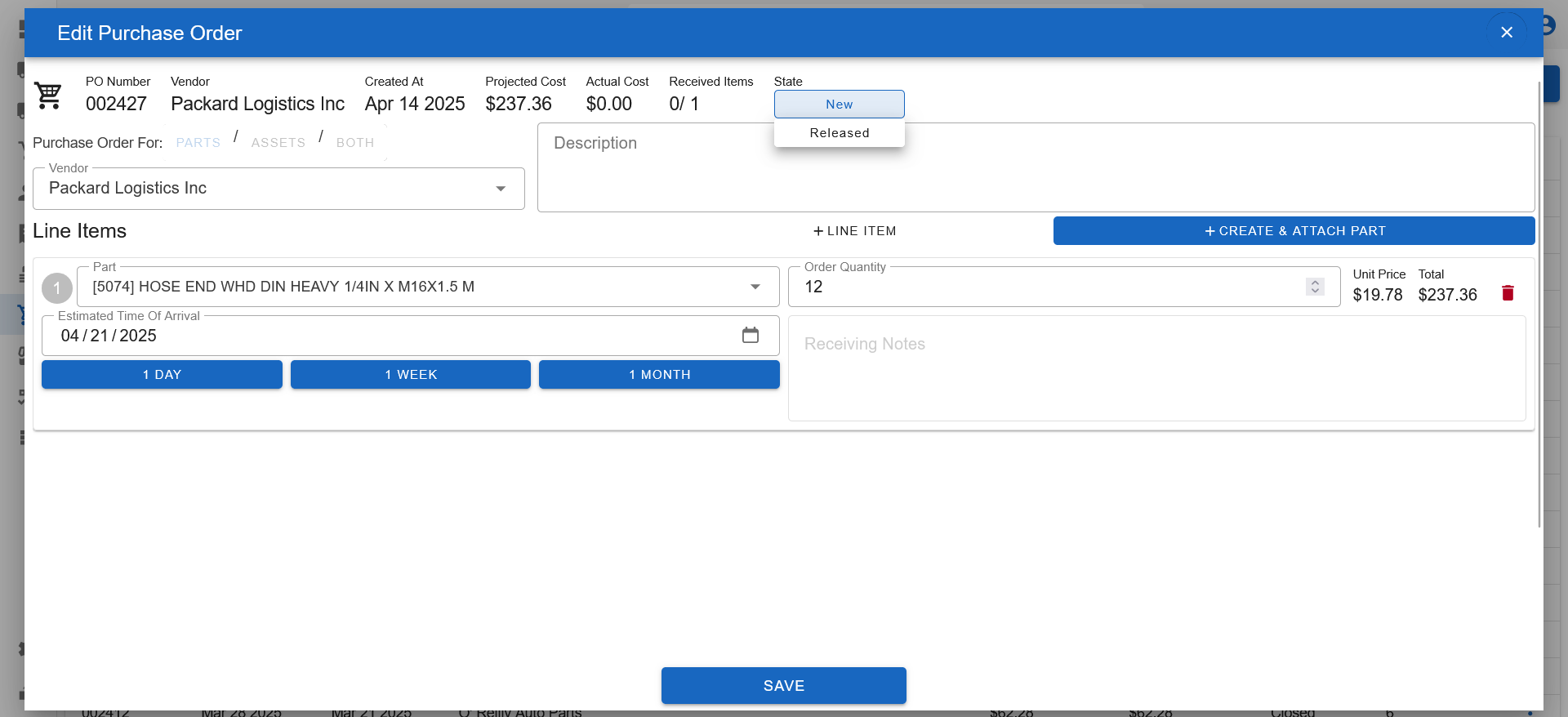
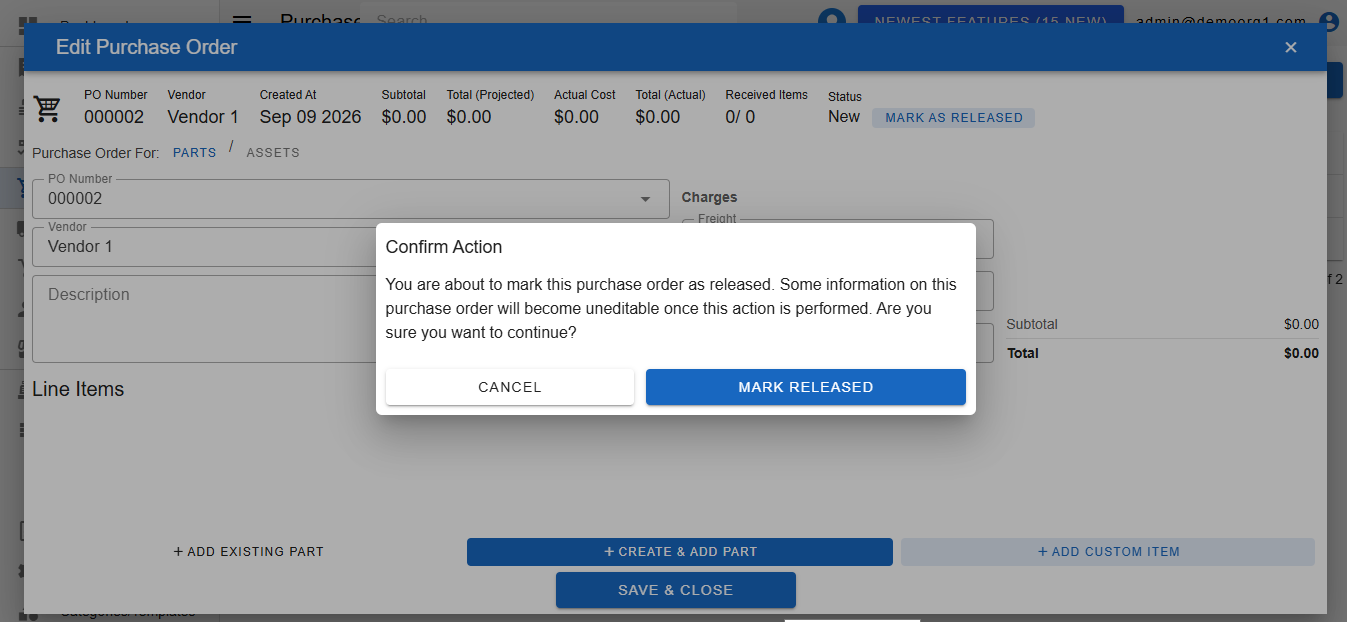
Clicking the new state will prompt the user with a confirmation dialog. The user can choose to continue, or abort releasing the purchase order.
Once the dialog is confirmed, the purchase order will be marked as released.
INFO
The state-change button (Mark as Released, Close Short, or Mark as Closed, depending on the purchase order's current state) is only enabled for users with the matching permission — releasing and closing are controlled separately, and an organization may also require the releaser/closer to be a different person than whoever created the purchase order. Without the right permission, the button is shown disabled with a tooltip explaining why (for example "You don't have permission to release/close this purchase order."). The same restriction applies to the equivalent action on a purchase order's row on the Purchase Orders Page.
Step 3 - Receive Items
Once a purchase order is marked received, much of the previously editable fields in the purchase order will become view-only. The Purchase Order Popup now only allows user to update selected info against an item on the purchase order, namely quantity of items received, receiving notes, and a checkbox that marks the item's reception as complete.
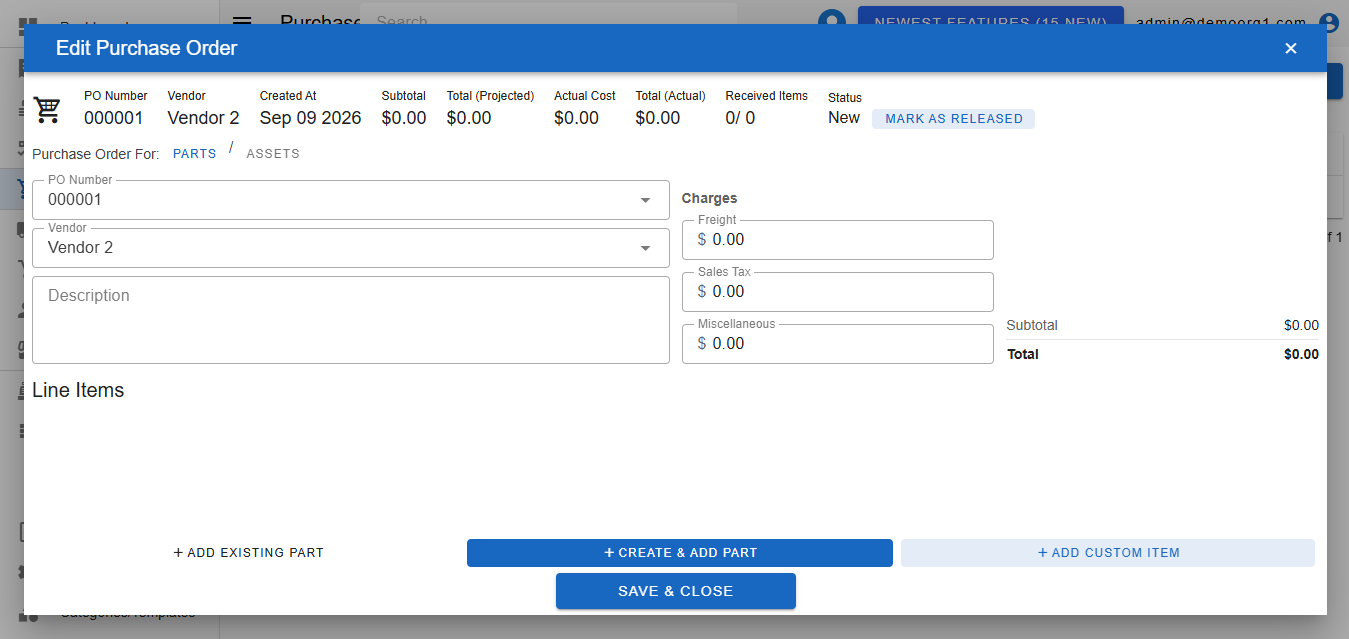
An item can be marked as received at any time, even when the items have only been partially received or not received at all. Marking an item received indicates that the reception of an item against the purchase order is complete, and no more quantity for that item will be received within the purchase order.
When an item is marked received with partial or zero received quantity, the user will be prompted with a confirmation dialog, asking the user if they have received the total ordered quantity.
The user can choose to mark the item as totally received (i.e. items were received in ordered quantity), or choose to keep the previously entered received quantity (i.e. items received were less than ordered quantity).
Once quantity is confirmed, the item is marked as received. By default a received item is read-only afterward, but users granted the received-state purchase-order edit permission can still edit a received item's Order Quantity, Quantity Received, Receiving Notes, Capitalized flag (shown only when Enable Capitalization is on), and Estimated Arrival after receipt. A received quantity of zero is allowed; only negative quantities are rejected (Quantity received cannot be negative).
INFO
Raising a received line's Order Quantity past what has already been received re-opens that line for further receiving — its Mark As Received checkbox clears, and if the purchase order itself had moved to received, it drops back to partially_received so the extra units can be received. The same applies to a line on a partially_received purchase order, for users granted that state's edit permission.
INFO
Receiving is its own permission, separate from the general purchase-order update permission — an organization may require whoever receives goods to be different from whoever purchased them. Without it, the Quantity Received field and Mark As Received checkbox are disabled, with a tooltip reading "You don't have permission to receive against this purchase order."
Custom line items are received the same way as parts and assets: enter the Quantity Received (shown alongside the Order Quantity), add optional Receiving Notes, and tick Mark As Received (the label flips to Received once ticked). Marking a custom item received with a partial or zero quantity triggers the same received-quantity confirmation dialog described above, and a received custom item becomes read-only.
Once all items are marked received, the purchase order will automatically transition to the received state.
To close the purchase order, head to Purchase Order Popup again. On the popup, the info bar at the top shows the purchase order's current state next to a button for transitioning it to its next state (in this case closed).
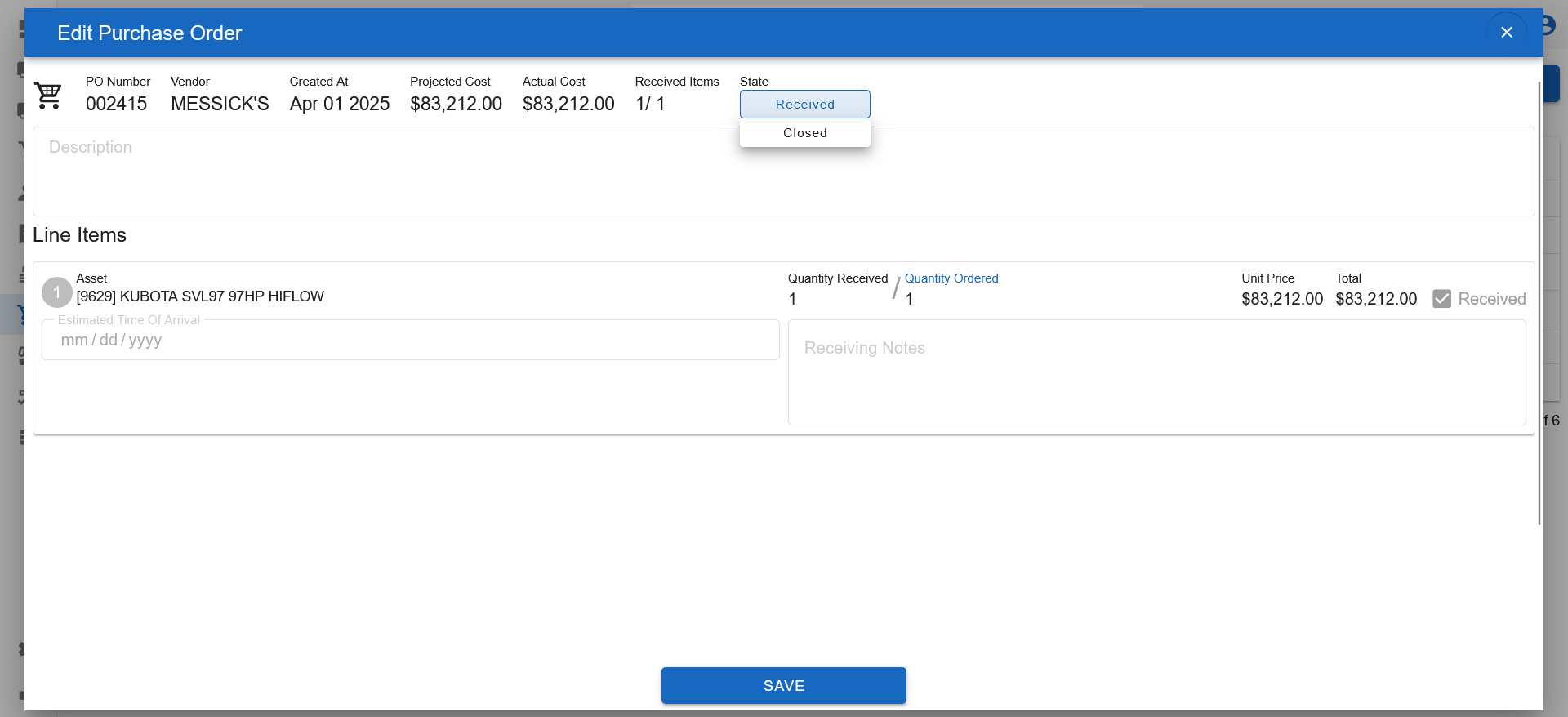
Clicking the button will prompt the user with a confirmation prompt, requiring the user to enter closing notes before marking the purchase order as closed.
Once the prompt is confirmed, the purchase order will be marked as closed.
Closing a partially received purchase order short
A partially_received purchase order can also be closed before its remaining items ever arrive. On the Purchase Order Popup (and from the action menu/promotion button on the Purchase Orders Page), the button next to the state reads Close Short instead of Mark As Closed while the purchase order is partially received. Clicking it prompts for closing notes the same way, and confirming transitions the purchase order straight to closed — its still-outstanding line items are left as-is, no longer expected to be received.
Voiding a purchase order
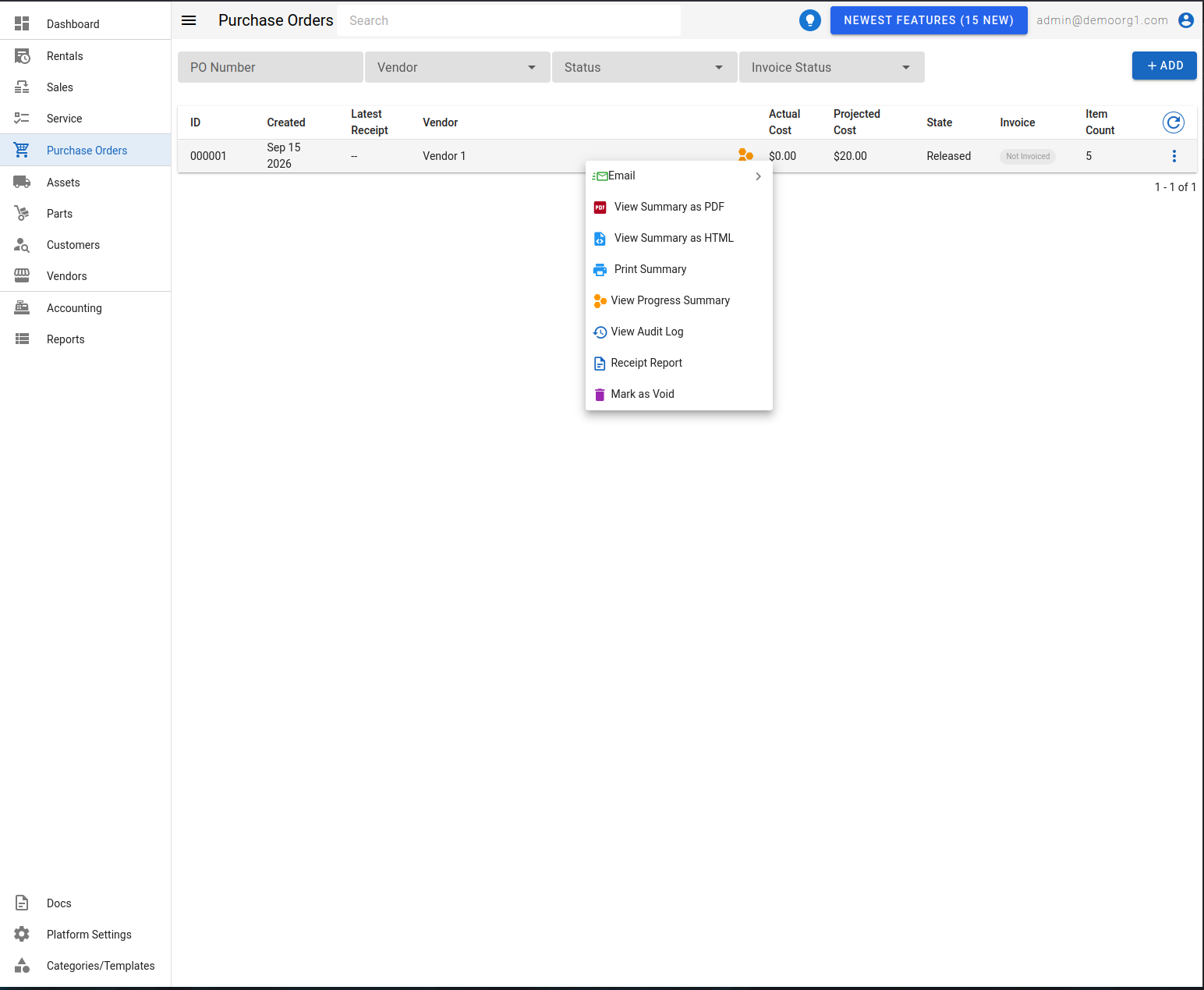
A purchase order can be voided to cancel it entirely. The Mark as Void action is available from a purchase order row's action menu on the Purchase Orders Page for new (draft) purchase orders, and — for users with the released-purchase-order update permission — for released purchase orders too. It is not available once a purchase order is received or closed.
INFO
A released purchase order that has already received any items cannot be voided — the action is disabled with the tooltip "This purchase order has received items and can't be voided. Close it short instead." Use Close Short (above) for a partially received purchase order.
Clicking Mark as Void opens a Confirm Purchase Order Voidance prompt that requires a Reason for Voidance. If the purchase order has line items, the prompt warns first — "This purchase order has N item(s). Voiding it will also permanently delete any assets/parts that were created on this purchase order." Provide a reason and confirm with Void Purchase Order to move it to the void state.